Un ballo in maschera

You will soon experience what happens when I have the opportunity to interview Verena von Kerssenbrock for a whole hour about her production – or, to be honest, to grill her. The following is, as always, my very personal opinion – this time with many deep insights into Verena von Kerssenbrock's directorial concept!
There are operas that tell stories of love and betrayal. And there are operas that were themselves a drama of betrayal, disguise, and narrow escape from censorship before the first note even sounded. "Un ballo in maschera" is both at once – and that is precisely why it is one of the most exciting templates that a directing team could wish for: an opera about masks, written under the compulsion to wear a mask itself.
The Plot
Riccardo, governor of Boston, secretly loves Amelia – the wife of his best friend and closest confidant Renato. When Ulrica, the fortune teller, predicts to Riccardo that he will soon die at the hands of a friend, he merely laughs it off. During a nighttime meeting, Riccardo and Amelia confess their love to each other, but Renato discovers the truth behind Amelia's veil – and, out of betrayal and despair, joins the conspirators against his once-friend. At the titular masked ball, Renato draws the lot of the assassin and kills Riccardo. Dying, he forgives everyone and confirms Amelia's innocence – an ending that elevates the opera beyond mere revenge ballad.
An opera that was born twice
Before Verdi wrote his governor, he wanted to have a real king assassinated. The original template was the actual murder of the Swedish King Gustav III, who fell victim to an assassination at a masked ball in the Stockholm Opera in 1792. After an assassination attempt on Napoleon III in 1858, the censorship authorities in the Kingdom of the Two Sicilies, where the opera was originally supposed to premiere in Naples, found a monarch shot on stage too politically immediate. Verdi had to rewrite: The Swedish king became an English governor of the American colony of Boston, and Stockholm became a New World, where a shot official was far less delicate than a shot king.
This American version – with Riccardo instead of Gustav, with Renato instead of Anckarström – is the one that premiered in Rome in 1859 and is also the one we will hear. Some houses are returning to the original Swedish version today because it is historically closer. But it is precisely the American disguise that has its own charm: It makes visible what the opera is already negotiating – that power, no matter what costume it appears in, reveals the same human abysses.
The Production
Even during the overture, the actual piece begins – only without a single sung note. We see a man in the theater, surrounded by costumes and masks, encouraged by two Harlequins to transform into a king. He finds a small, white toy triumphal arch – and, barely having passed through in spirit, plays himself right into the dream of kingship. This little white toy will not let him go: As a king, he later has angels made for him. (A rascal who thinks of current politicians when it comes to triumphal arches and grand halls!) A tin soldier stands beside him and already shows here, in all silence, what will drive the entire opera: the power of the army that is supposed to protect a king – and its powerlessness when it matters.
When the curtain finally rises for Act 1, the dream has come true. Or has it not quite? The theater boxes still flash above, the curtain still lurks somewhere in the background – we are never quite sure if we have arrived in reality. Our Sun King awakens, surrounded by courtiers who fully costume him into his new office. Only one wears no disguise: Renato, the loyal, honest friend – the only character who initially is still what he seems to be.
And this king falls not only in love with Amelia but first and foremost with the idea of power itself: I want everything, I get everything – even the woman I desire! And everyone joins in. Amelia, on the other hand, wants to love and yet remain faithful and seeks advice from the fortune teller Ulrica. Her prophecy that Riccardo will die is dismissed by him with a Harlequin hand puppet – a toy that playfully wipes away a deadly truth because he does not want to know anything about it.
The more the truth makes its way, the less theater remains – and the darker what emerges becomes. Costumes are changed on stage, court ladies become "simple village women" – only that in the rush the wigs remain on their heads. The king appears in a fisherman's costume – appearance and truth wrestle with each other throughout the evening, and no one wins completely. Ulrica herself appears only in brief flashes of truth – is it truth or merely the coincidence of a prediction?
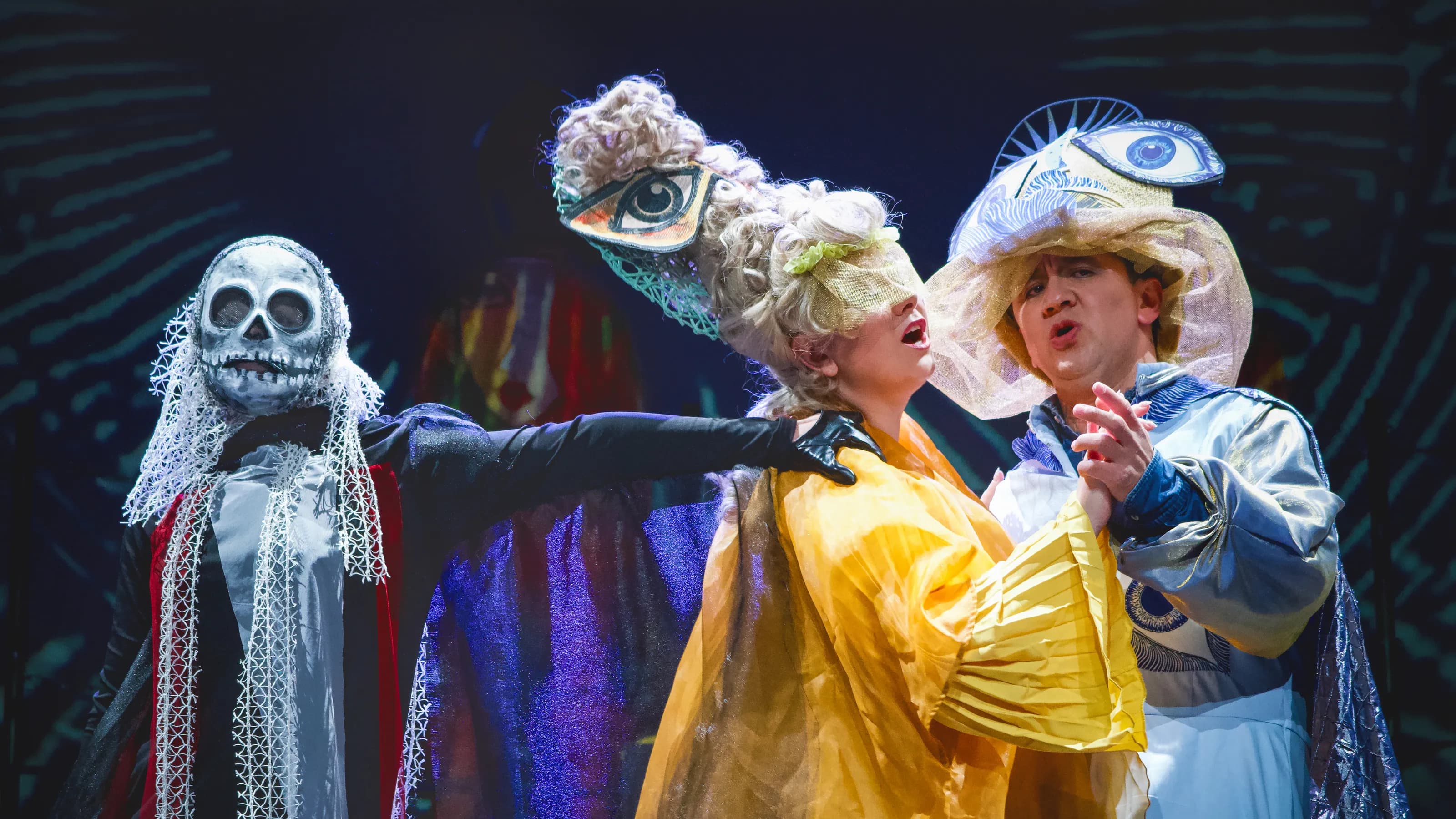
When the king is recognized by too many, he changes back into his royal garb amidst cheers - and those who look closely will see one of the many small but expressive details of the evening: Death itself brings in the royal costume to change into and hands it over – Renato. The friend thus hands over the death costume to the man he still believes to be his friend. A silent image that tells more than any dialogue: Betrayal and loyalty, love and murder lie for this one moment in the same costume.
In the search for the herb that is supposed to help Amelia be honest, Riccardo secretly follows her. He reveals himself, and from this encounter comes the famous love duet, in which both are finally honest with each other. But while they confess what they feel, the underworld is already becoming visible in the background: Death dances along – and observes what Renato is also observing: the love scene between his wife and his best friend.
When Renato learns of his wife's love for the king, the catastrophe takes its course. The marital quarrel and Renato's subsequent betrayal – now he, the only one unmasked, is in the costume of the liar – are part of our director's declared favorite scene: We experience the conspiracy up close, right down to the drawing of lots for the murder.
And then, at the very end, the circle closes: While the king sings his last, dying aria, the second Harlequin from the beginning returns – with the king's? bedding in his arms. The king falls into it, and we are no longer quite sure: Has he just died, or has he merely awakened? Was the whole kingship, all the splendor, all the guilt and all the betrayal nothing but a dream from which Death himself carries him back to bed? Verena von Kerssenbrock consistently does not answer this question – and therein lies the point: The play between dream and reality, with which the evening began, does not cease even in death.
As always, Verena von Kerssenbrock designed and selected the stage set herself – some of the background paintings even come from her own hand. Pay particular attention to the eye as a recurring symbol of truth: Sometimes it stares at us from a mirror, sometimes it quietly admonishes in the background or is hidden on a costume. And keep an eye on Ulrica's disc – a snail that shows the course of the world: It continues to turn, undeterred, even when the splendid room from the beginning has long since transformed into a dance of death. Heaven and hell, good and evil, just punishment? The truth is indifferent to that. It will come to light anyway. Even if we sometimes wish that this was all just a bad dream...
Music that gets under your skin
Verdi unusually consistently mixes lightness and abyss in this opera. The page Oscar provides comedic momentum, while the main plot increasingly darkens – a contrast that makes the catastrophe at the end hit all the sharper. Ulrica's fortune-telling scene in the first act is one of the most atmospherically dense moments of the score: almost occult sound colors from which the entire tragedy takes its origin. And the love duet in the second act is one of the most emotionally intense moments in Verdi's entire oeuvre – that brief, precious moment when two people are honest with each other, just before the world around them begins to lie again.
For the title character, this means one of Verdi's most demanding tenor roles: Riccardo must alternate between radiant heights and lyrical delicacy, must convincingly portray the charming ruler as well as the man who forgives even in the face of death. A feat – and exactly the stuff that great opera evenings are made of.
Friendship and betrayal, fate and free will, forbidden love and the greatness of forgiveness: "Un ballo in maschera" negotiates great themes in the small framework of a masked ball – and reminds us that the most interesting truths often lie behind a disguise.
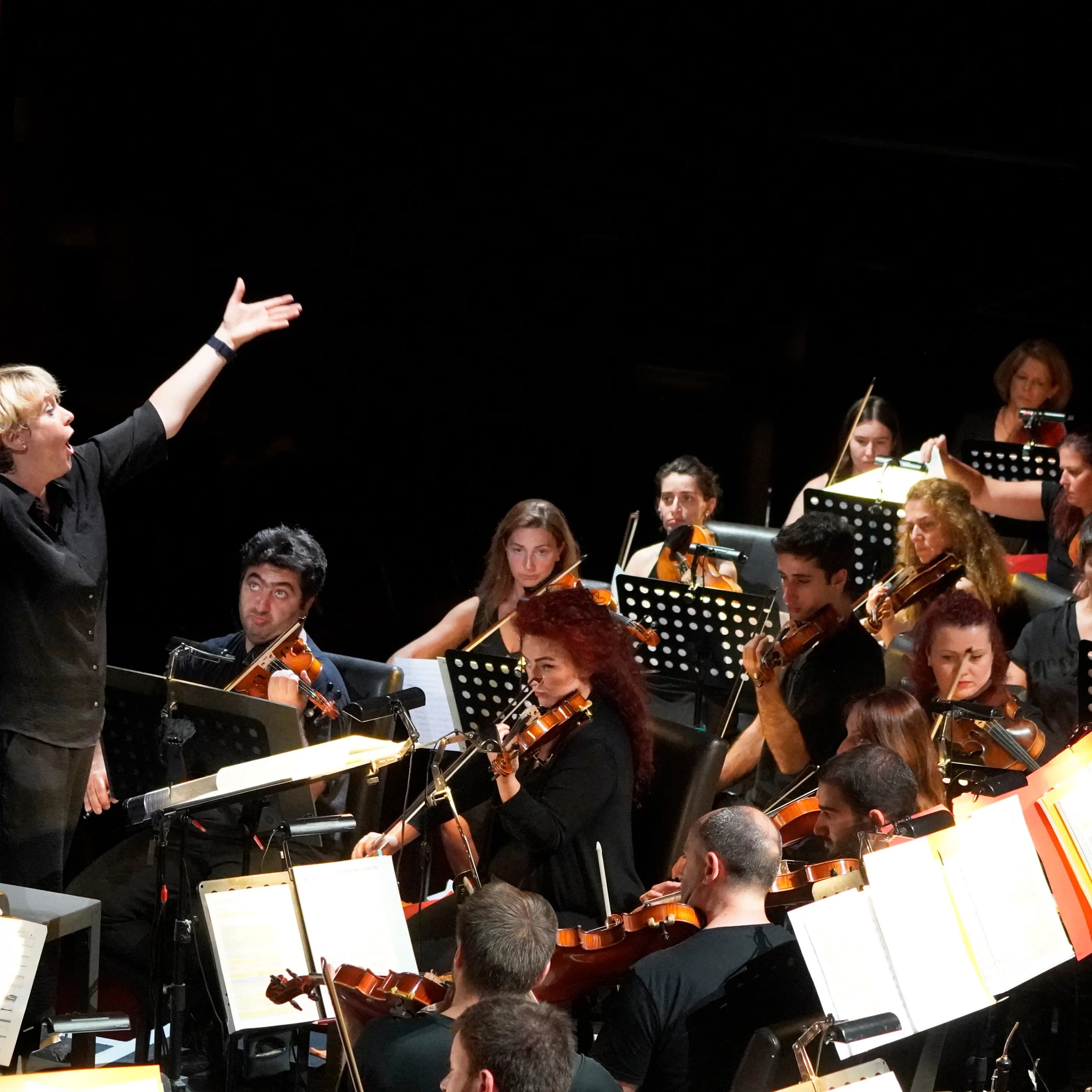
You have never experienced the masked ball like this – a Kerssenbrock production is always worth a visit – and when a Kerssenbrock conducting is added, reality becomes a single dream...
See you on the hill.
Warm regards
Your Christiane Berker