The Magic Flute or: What You Always Wanted to Know About Mozart but Were Too Afraid to Ask

First a note: This text represents the personal opinion of Christiane Berker – what I think when I engage with The Magic Flute…
Opera is, as we know, "completely outdated." But The Magic Flute? It is so un-outdated that it is still on the program of every single opera house in the world today. Not even Wagner can claim that. And Mozart wrote it in a state that would drive any modern self-optimization coach insane: at 35 years old, sick, in debt, and with the faint feeling that time might be running out. He was right. The world premiere was on September 30, 1791. Mozart died on December 5, 1791. Sixty-six days later.
But let's take it step by step. The story is likely known to everyone, so this time there is no content, but rather what happened around it…
Two broke birds of prey in search of the big hit
The story begins with two men in financial distress. Emanuel Schikaneder – actor, director, librettist, and notorious bon vivant – ran the theater in Freihaus on the Wieden in Vienna. This was not a court theater, not a palace of high society; it was a folk theater, a carnival of the senses, the equivalent of today’s multiplex cinema: little magic shows, puppetry, flying machines, fountains of fire. And Schikaneder urgently needed a box office hit because his cash register was… let’s generously call it "manageable."
Wolfgang Amadeus Mozart was also in a manageable situation regarding his finances. He wrote letters to his friend Michael Puchberg with phrases that we would today describe as "account balance panic." So: two indebted friends, a commission, an opera. Schikaneder asked Mozart to write him a magic opera – with everything the audience loved: spectacle, humor, touching moments, and as many transformation scenes as possible. Mozart agreed. Perhaps because he had to. Perhaps because he was excited by the idea. Probably both.
What came out of it is still one of the most performed stage works in the world today. Schikaneder became rich. Mozart experienced the success only in glimpses.
The Freemason who was no longer a Freemason – and yet participated
Now we need to briefly talk about Freemasons. Mozart was one, and he took it seriously. The lodge was not a social accessory for him, but a genuine conviction: enlightenment, humanism, brotherhood. Schikaneder had also been a Freemason – but he had been expelled from the Regensburg lodge. The official reason? Unsubstantiated relationships with the wife or daughter of a lodge brother. Historical research formulates this cautiously. Contemporaries were less reserved.
The entire opera is full of Masonic symbolism, and this is no coincidence. The trials that Tamino must undergo – silence, water, fire – reflect the initiation rites of the Freemasons so faithfully that Mozart incurred the accusation of revealing secrets from some lodge brothers. And this brings us to my favorite rumor in opera history: that Mozart was poisoned by Freemasons because he revealed too much in The Magic Flute.
Of course, that is nonsense. But what wonderfully dramatic nonsense. In reality, Mozart most likely died of a kidney disease, possibly exacerbated by not entirely contemporary medical treatments. Still: the thought that an opera could be so dangerous that one pays for it with one’s life – that has something! The Magic Flute as a thriller - why not?
And then there is the holy number three, which runs through the entire opera like a red – or rather triangular – thread. Three ladies, three boys, three slaves, three temples. The overture begins with three chords. The trials are three. Everything is three. One wonders how Schikaneder counted while writing the libretto. With the fingers of one hand, consistently only up to three.
The sister-in-law sings – and Mozart writes her the most impossible aria in opera history
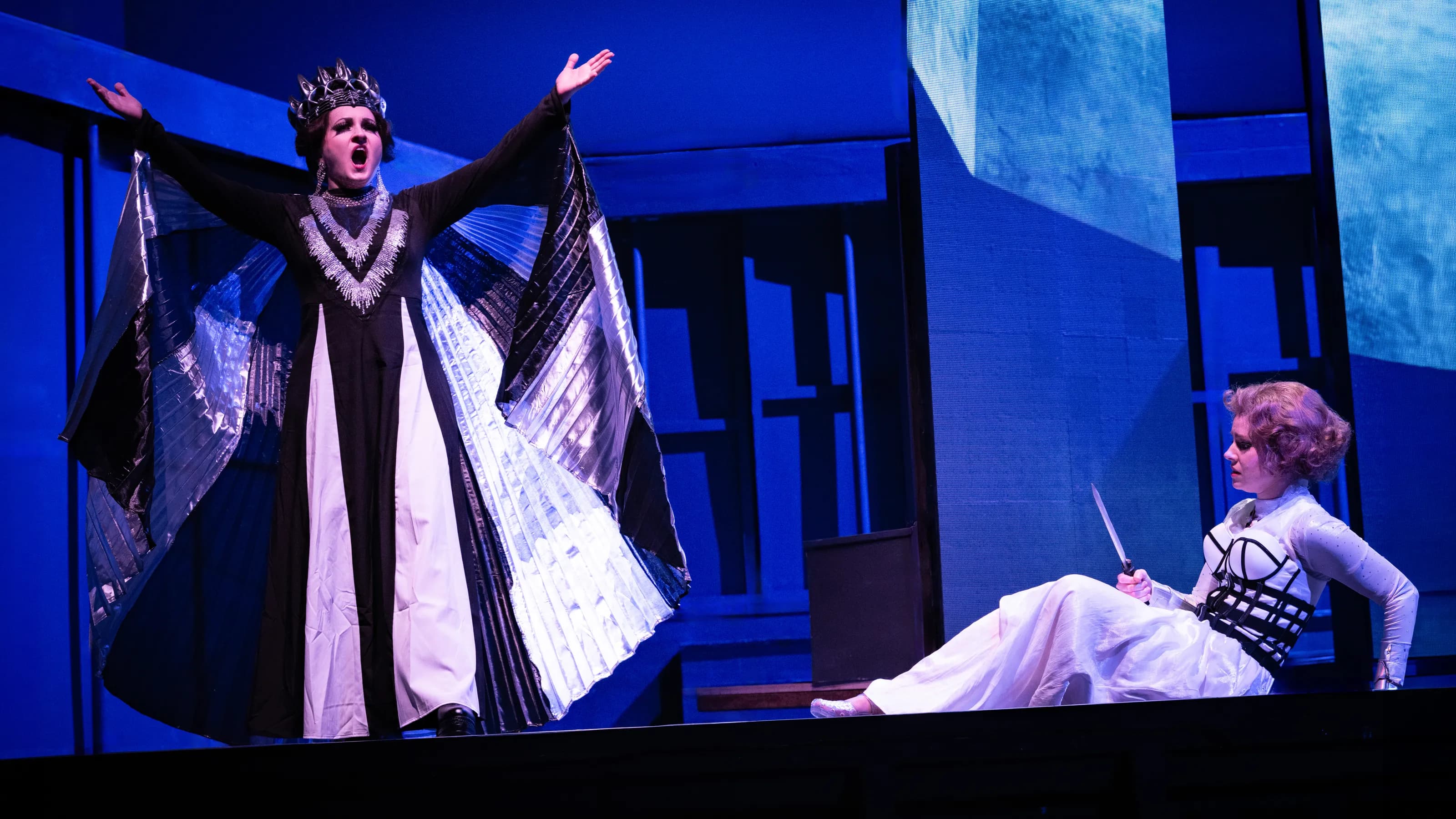
The role of the Queen of the Night – this world-dominating, vengeful, breathtakingly evil figure – was sung at the premiere by Josepha Hofer. Josepha Hofer was Mozart's sister-in-law. The older sister of Constanze Mozart. Just imagine: Mozart writes an aria for the older sister of his wife that explores the absolute limits of the human voice.
"The vengeance of hell boils in my heart" – the revenge aria in the second act – is still the ultimate challenge for the coloratura soprano. The high F that the singer must hit in this aria is the highest note ever systematically demanded in the opera repertoire. Not occasionally, not as an effect, but as an essential part of the drama. Mozart knew Josepha's voice well. He literally wrote this aria "into her throat," as one says.
Today there are singers who specialize in this role. And those who sing it once and never again. The Queen of the Night is the Mount Everest of the soprano repertoire: everyone knows it exists, but most prefer to look at it from below.
The glockenspiel prank: Mozart, the bread roll conductor
Schikaneder himself played the role of Papageno at the premiere. The birdman costume, the comedic interludes, the favor of the audience – he loved it. Papageno was his signature role. And Schikaneder mimed his glockenspiel performance so convincingly, as if he were playing the instrument himself, that the audience believed it.
What the audience did not know: Mozart sat in the orchestra pit and played the glockenspiel himself. And Mozart, this great composer, this titan of Western music, this free spirit and humanist – decided one evening to play a prank. During one of the breaks, while Schikaneder was waiting for his next entrance, Mozart simply continued playing. Another arpeggio, another chord, completely unannounced.
Schikaneder, on stage, in full costume, in front of hundreds of spectators, paused. Listened. Then continued playing. The next time: Mozart did not play. Schikaneder paused again – and reacted as great theater people do in such situations: he struck his (prop) glockenspiel against the next prop and shouted into the wings: "Shut up!"
No biographer has yet been able to explain how the audience reacted. I imagine it became completely silent for a brief moment. And then… well, we know the audience of The Magic Flute. They laugh. They have always laughed. That is an essential part of the work.
"The applause was moderate" – and then came the storm
The criticism of the premiere was – let’s say: thought-provoking. The Musical Weekly concluded that "the applause was lacking because the content and language of the piece were far too poor." This referred to Schikaneder's libretto, which, with its colorful mixture of Egyptian mythology, Masonic symbolism, folk theater humor, and philosophical ambition, posed puzzling questions to aesthetic critics.
And the libretto is indeed… interesting. The plot has a logic that is best not questioned too closely. The Queen of the Night is initially introduced as good, then suddenly she is the evil one. Sarastro first appears as a dark kidnapper, then turns out to be a wise high priest. The Moor Monostatos is evil from the very beginning – which often poses problems for today’s opera direction and leads to reinterpretations that are sometimes enlightening and sometimes… ambitious. Papageno seeks a Papagena and finds her after several detours that could be described as not entirely compelling dramaturgically.
Mozart drew from this colorful chaos music of astonishing beauty. "Ah, I feel it," Pamina's aria of abandonment. The priest's chorus. Papageno's pan flute playing. The overture, which begins with these three chords and never lets go. One sits in the audience and wonders how a person could have written this – terminally ill, in debt, sitting in a back room of a Viennese theater, with death at his back.
Within weeks of the premiere, The Magic Flute became a box office hit. Schikaneder performed it 200 times in a row. On October 7, 1791, Mozart wrote a letter full of enthusiasm to his wife Constanze, who was undergoing treatment in Baden near Vienna: he had been to the opera, sat in the orchestra, and played along. He was happy. A few weeks later, he was dead.
What remains
What I love about The Magic Flute is exactly what its critics accuse it of: it is unbearably multifaceted. It is simultaneously a children's fairy tale and a Masonic secret, a folk theater fun and a philosophical treatise, a turbulent romantic comedy and a solemn mystery play. No other opera work holds these contradictions together so effortlessly.
Tamino and Pamina pass their trials and find each other – through courage, silence, love, and a flute that truly works magic. Papageno finds his Papagena in a simpler, more human way: he simply wants her very, very, very much. The Queen of the Night loses and crashes into the abyss – with perhaps the most irresistible music ever written for a villainess.
And Sarastro? He stands there with his wisdom and his priests and his somewhat patriarchal order of things – and sings "In these sacred halls" with a voice that even the most modern director briefly forgets to criticize and simply listens.
That is The Magic Flute. Disorderly, contradictory, crazy, magnificent.
In Immling, we will experience it this summer. Let yourself be surprised by what our very own magician Ludwig Baumann has made of it this time – after all, it all started on the hill 30 years ago with The Magic Flute…
In this sense – see you soon!
Yours, Christiane Berker