Lucia di Lammermoor – Feminist? Or are we just giving 50 percent of humanity a voice and a face?

This question arose for me immediately after the introduction by director Ella Marchment at the sponsor evening – and made me very curious about her interpretation of the opera (small reminder: here only MY very personal views and insights are presented...)
But first, the content:
Gaetano Donizetti writes an opera set in Scotland – based on a novel by Walter Scott, premiered in 1835 in Naples.
Lucia Ashton lives in the shadow of her tyrannical brother Enrico, who seeks to save the impoverished Scottish nobility of the family. Secretly, she loves Edgardo di Ravenswood, the arch-enemy of her family – but Enrico prevents the connection, forges letters, and persuades Lucia to marry the wealthy Arturo Bucklaw. On her wedding night, Lucia kills her groom and descends into madness – the most famous madness scene in opera history. When Edgardo learns of Lucia's death, he takes his own life.
Well, it's opera – in the end, everyone is dead again... But it's not that simple.
Marchment's statement hits the nail on the head: "From the beginning of the rehearsal process, we did not want to view 'Lucia' simply as the story of a woman who 'goes mad', but as the story of a woman trapped in systems of power and expectations who ultimately tries to free herself from them. We asked ourselves why Lucia's story still feels so familiar today." (Translation from English: C. Berker)
For me, the term pair "male / female gaze" immediately comes to mind – coined in 1975 by British film theorist Laura Mulvey. The female body as an object that exists for the viewer, not for itself. With Female Gaze, it does not become a simple opposite, but a fundamentally different way of looking. Emotions, vulnerability, and relationships take center stage, beyond desire and control. This is not about biology, but about established conventions of seeing – analysis, not accusation! – this applies regardless of the gender of the artists. In Donizetti's opera, this gaze is structurally embedded: Lucia is looked at, judged, married, pitied. Only in the madness scene does she force the opera to look through her – not at her.And so Ella Marchment says that the visual world she shows us is structured around a very clear contrast. Men, within power, are represented by various shades of red. The women we experience outside, dressed in pure white. Only when they choose to engage with the power structures do they don red – accomplices, but also drivers of the story.And then there are the women of the (ancient) chorus: As a collective dramatic element with its own function, the chorus comments on the events without directly intervening. And it is not an anonymous chorus – Ella Marchment allows female figures from history, mythology, and opera to appear, who know Lucia's experience because they have themselves been victims of power structures. They are close to the main character without having power themselves. They comment without intervening. A private drama gains collective significance.Think of Cleopatra, Mary Stuart, Joan of Arc, Iphigenia, Helena, Anna Karenina, Ophelia, Violetta, Madama Butterfly, Norma, or Salome and the many, many others. None are passive out of weakness. What unites them: laws written by men. Societies that treated women as property. And artworks that repeatedly told their tragedies – without naming the structures that caused them.Once again, Ella Marchment: "At the beginning and end of the opera, you will see short film sequences with little boys. These moments frame the piece and leave us with an important question: Do these cycles simply repeat over generations? Is there hope that society will change, or is power so deeply rooted that this story will remain cyclic forever? We end with a question, not an answer.
And ultimately, that may be the central question of this production:
Not 'Why does Lucia go mad?', but rather 'Why does society continue to create Lucias? And will society continue to create Lucias?' (Translation from English: C. Berker)
No man in the opera treats Lucia as an autonomous subject – she is material that is managed. And then there is Barbie. What does a Barbie doll have to do with an opera from the 19th century? Ella Marchment has a directorial idea for this that works – and we won't reveal it here. Come and find out.
Only in madness can she speak freely – and we listen to her! Gilbert & Gubar's foundational work "The Madwoman in the Attic" (Gilbert & Gubar, 1979): Women who conformed on the surface – and hid a subversive narrative underneath, embodied by the madwoman.
Madness as the only form of resistance.
Lucia can only speak freely in the madness scene "Il dolce suono" / "Spargi d'amaro pianto". The aria is considered the pinnacle of Belcanto and one of the most difficult scenes ever written for a soprano.
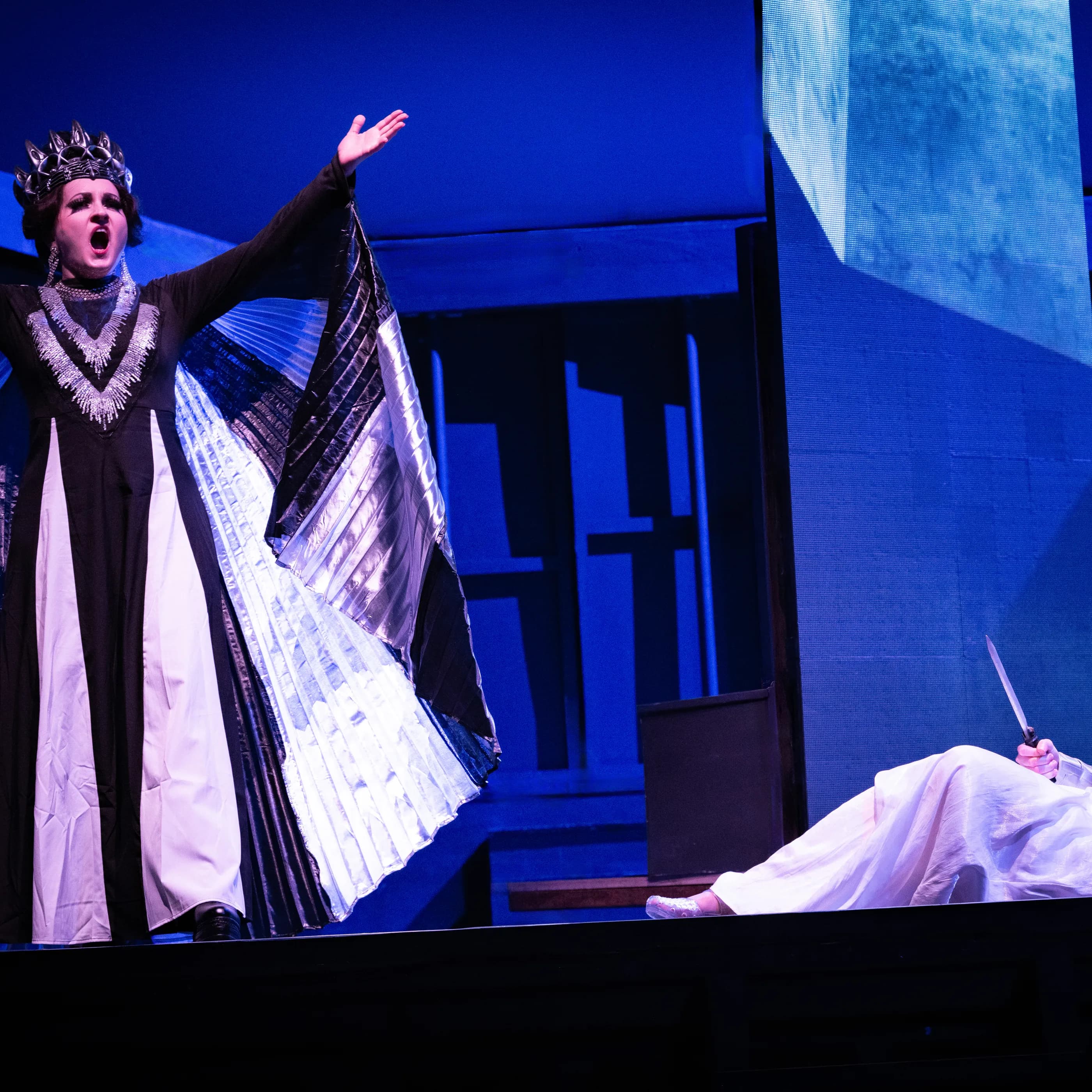
She enters the stage after the wedding night – she has killed her groom, is bloodstained, recognizes no one. What follows is not a breakdown, but something much more terrifying: She is completely calm, almost tender, fully immersed in her own inner world. She believes she is united with Edgardo. The discrepancy between what the audience sees – blood, horror, collapse – and what Lucia feels – blissful love – creates unbearable tension.
The aria demands delicate pianissimi, breathtaking coloraturas, long arcs – and that after two long acts in which the voice has already been fully engaged. The singer must simultaneously show the highest vocal control and complete psychological loss of control – a fundamental contradiction that makes the scene so captivating.In Immling, this extraordinary role is sung by Ukrainian soprano Inna Fedorii. Born in 1996 in Ternopil, she initially studied choral conducting before turning to singing and completing her master's degree at the National Music Academy of Lviv in 2021. Her talent was noticed early on: in 2017 she won the Oksana-Petrusenko competition, and in 2018 she was a finalist at the Eva-Marton competition in Budapest – named after that very soprano who is among the legendary interpreters of Lucia. The Lucia in Immling is one of the most demanding roles that can be entrusted to a singer of her age – a clear signal of the trust the festival places in her.Donizetti composed the scene as a long, free sequence of sections without rigid form – it breathes, hesitates, breaks off, starts anew, just like a torn consciousness. The music does not imitate madness from the outside, but tries to show it from the inside. That was radical for 1835.Particularly famous is the interplay of the soprano voice with a solo instrument – in the original version a glass harmonica, which of course also appears in Immling (and is not, as is usually the case, replaced by a flute!). This instrument doubles, surrounds, and responds to the voice like a second self, like an echo from another world. The effect is dreamlike-unreal.Coloraturas as an outbreak from order. Excess as the only autonomy.
One last observation that perhaps goes the deepest: The man who loves Lucia the most – Edgardo – destroys her just as much as the one who hates her. Patriarchy functions not only through open hostility but also through loving control, through claims of ownership, through the inability to listen. That makes "Lucia di Lammermoor" a work that today, almost 200 years later, has remarkably little dust on it.
When you go home after the opera, please take with you a very important sentence that applies not only to women: "Watching is NOT enough to change something!"See you on the hill in Immling – this 30th anniversary really has it all, you can hardly catch your breath!In this sense, a bit breathless –As always, your Christiane Berkerfrei sprechen. Die Arie gilt als Gipfelpunkt des Belcanto und eine der schwierigsten Szenen, die je für eine Sopranistin geschrieben wurden.
Sie betritt die Bühne nach der Hochzeitsnacht – sie hat ihren Bräutigam getötet, ist blutbefleckt, erkennt niemanden mehr. Was folgt, ist kein Ausraster, sondern etwas viel Erschreckenderes: Sie ist vollkommen ruhig, fast zärtlich, vollständig in ihrer eigenen Innenwelt versunken. Sie glaubt, mit Edgardo vereint zu sein. Die Diskrepanz zwischen dem, was das Publikum sieht – Blut, Entsetzen, Zusammenbruch –, und dem, was Lucia empfindet – Liebesglück – erzeugt eine unerträgliche Spannung.
Die Arie verlangt hauchzarte Pianissimi, halsbrecherische Koloraturen, lange Bögen – und das nach zwei langen Akten, in denen die Stimme bereits voll beansprucht wurde. Die Sängerin muss gleichzeitig höchste vokale Kontrolle zeigen und vollständigen psychischen Kontrollverlust darstellen – ein fundamentaler Widerspruch, der die Szene so fesselnd macht.
In Immling singt diese außergewöhnliche Rolle die ukrainische Sopranistin Inna Fedorii. 1996 in Ternopil geboren, studierte sie zunächst Chorleitung, bevor sie sich dem Gesang zuwandte und 2021 ihren Master an der Nationalen Musikakademie Lemberg abschloss. Ihr Talent machte früh auf sich aufmerksam: 2017 gewann sie den Oksana-Petrusenko-Wettbewerb, 2018 war sie Finalistin beim Eva-Marton-Wettbewerb in Budapest – ausgerechnet benannt nach jener Sopranistin, die selbst zu den legendären Lucia-Interpretinnen zählt. Die Lucia in Immling ist für eine Sängerin ihres Alters eine der anspruchsvollsten Rollen, die man ihr anvertrauen kann – ein klares Signal, welches Vertrauen das Festival in sie setzt.
Donizetti komponierte die Szene als eine lange, freie Folge von Abschnitten ohne starre Form – sie atmet, zögert, bricht ab, beginnt neu, genau wie ein zerrissenes Bewusstsein. Die Musik imitiert keinen Wahnsinn von außen, sondern versucht, ihn von innen zu zeigen. Das war für 1835 radikal.
Besonders berühmt ist das Zusammenspiel der Sopranstimme mit einem Soloinstrument – in der Originalfassung eine Glasharmonika, die natürlich auch in Immling vorkommt (und nicht, wie meist üblich, von einer Flöte ersetzt wird!). Dieses Instrument verdoppelt, umspielt und antwortet der Stimme wie ein zweites Ich, wie ein Echo aus einer anderen Welt. Die Wirkung ist traumhaft-unwirklich.
Koloraturen als Ausbruch aus der Ordnung. Exzess als einzige Autonomie.
Eine letzte Beobachtung, die vielleicht am tiefsten geht: Der Mann, der Lucia am meisten liebt – Edgardo – zerstört sie genauso wie der, der sie hasst. Patriarchat funktioniert nicht nur durch offene Feindschaft, sondern auch durch liebende Kontrolle, durch Besitzanspruch, durch die Unfähigkeit zuzuhören. Das macht Lucia di Lammermoor zu einem Werk, das heute, fast 200 Jahre später, erschreckend wenig Staub angesetzt hat.
Wenn Sie nach der Oper nach Hause gehen, nehmen Sie bitte einen ganz wichtigen Satz mit, der sich nicht nur auf Frauen bezieht: Zusehen reicht NICHT aus, um etwas zu verändern!
Wir sehen uns auf dem Hügel in Immling – dieses 30-jährige Jubiläum hat es wirklich in sich, man kommt kaum zum Atmen!
In diesem Sinne etwas atemlos –
Wie immer Ihre Christiane Berker